SatNow - Development of a satellite-based nowcasting technique for extreme precipitation events [funded by DFG]
Project staff:
Kai Richter
Description:
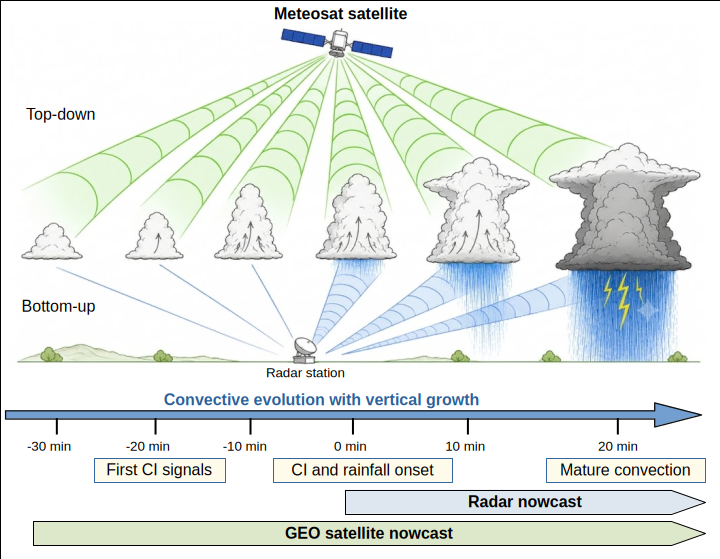
Climate change is leading to an increase in the frequency and intensity of convective heavy rainfall and thunderstorm events during summer months over Central Europe. This results in severe impacts on infrastructure and endanger human lives. Therefore, there is an urgent need for accurate nowcasting of extreme precipitation events to enable adequate adaptation and disaster management. The German Meteorological Service (DWD) has developed a new forecasting system called "Seamless INtegrated FOrecasting sYstem-SINFONY" that enables seamless prediction of weather events with damage potential and their probability of occurrence within the short-range forecast period (0 to 12 hours) based on the DWD`s radar network covering the area of Germany. However, radar nowcasting methods are limited to existing precipitation objects and land areas. Geostationary Earth orbit (GEO) satellite data on the other hand provide continuous information on clouds and precipitation with high spatiotemporal resolution, which is advantageous for detection of early convective initiation (CI) signals. Consequently, incorporating GEO satellite data into nowcasting applications has the potential to extend the lead time of radar nowcasting. In this context, nowcasting techniques based on advanced machine learning (ML) show improvements compared to traditional advection techniques. The SatNow project aims to develop a GEO satellite-based technique for probabilistic nowcasting of CI and convective evolution of detected cloud cells over Germany using advanced ML techniques.This project is kindly funded by the DWD as part of its extramural research (EMF) program.
Research cooperation:
Dr. Richard Müller, German Meteorological Service